This is an interpretive dance performance starring Jade Chynoweth and Janelle Ginestra to the song "Without Me" by Halsey (the title of the Youtube video gives the incorrect name of the song). One large center screen and two smaller screens to either side of it serve as the backdrop for the two dancers. The screens show glitching, abstract images of clouds. Surrounding the screens are brightly flashing LED lights. The color palette is limited to light blues, purples, and pinks throughout the performance. Limited color palettes seem to be a popular choice in dance lighting design. The flashing lights create the feeling of a lightning storm, and greatly add to the emotional intensity of the dance. The lighting complements the the performance in other ways - colors change, the lights cut out, increase in intensity, and flash at significant moments in the song. There is some sort've soft light focused on the dancers from the front, so that their actions are visible, but the intense back lighting accentuates their figures. And, backlighting is always dramatic.
Tuesday, May 12, 2020

Dance Lighting 2
This is Jojo Gomez's choreography for "You Should See Me in a Crown," by Billie Eilish. The lighting design follows the pattern of general dance lighting (that I have seen) - limited color palette, and heavy backlighting. The bright backlights alternate between green and pink, while a pink light shines on the dancers from their left, and a warm white light shines from their right. These two side lights are constant throughout the dance. The backlights change according to the narrative of the dance and song. When the chorus begins, they abruptly change to a cool white and begin strobing. Then, they turn a yellow-orange and pulsate, which, in combination with the warm white and pink sidelights, feels uncomfortably warm (which is good, as discomfort is the objective of this choreography). The reflective surface of the floor helps create a disorienting feeling (it seems like the lights continue downwards, as if there were no floor).
Moody Lighting 1

This photograph was taken by Chloe Taddie. The two small lit windows, each silhouetting a figure, amid pitch blackness creates a striking scene. The mood is difficult to pin down as moods often are, but it feels rather somber. From the difference in color and height of the lights, the void that separates them, as well as the fact that the figures seem to be looking towards one another (though they might not be able to see each other), we are encouraged to form a narrative. This narrative strikes me as perhaps a sad one. These people live in vastly different worlds - one's evenings are illuminated by neon and fabulous hair, the other's are characterized by an impersonal yellow-green light. They do not know or understand one another, but want to. As a small note, the faintly lit profile of a roof in the bottom right corner serves as a small marker of the picture's location. Without this the windows would appear to be floating in space.
Moody Lighting 2

This image was captured by Kolja Eckert. There looks to be a single source of intense white-gold light receding far back into the picture plane. The room of chandeliers, with thousands of crystals, reflects and multiplies the light. It has a dreamy, ethereal mood. The partially washed-out figure in the foreground stands with her side facing us, half-engaged in this dream of gold and diamonds. The intensity of the light blurs the figure and the light fixtures, and reinforces the scene's surreal quality.
Monday, May 11, 2020
Gobos and Texture

image source: https://bavservices.com/item/textured-mesh/
Though this example of lighting is not technically in the context of theatre, it could easily be adapted to a theatrical setting. The simple projection of color-changing LEDs over a layer of crumpled mesh (I am not quite sure what material it is) gives the illusion of a dramatic rock wall, with bright highlights and stark shadows. This might be an efficient way to create naturalistic stage scenery. As the backdrop for this corporate event however, I might say this lighting texture is a tad too dramatic.
Gobos and Texture

Lighting designer James Davis created this effect for a production of The Tempest by experimenting with various glass gobos. This particular mystical light effect was created with Rosco's ColorWave #33103 Magenta Ripple, in a spinning gobo rotator. The warm, seemingly sparkling hues in this are a stunning contrast to the deep blues around it. In this particular still, the effect looks to be moving, and perhaps originating from the actor's outstretched hand. It has the feeling of magic, which was the desired effect.
Thursday, April 30, 2020
Dance Lighting

This photo is striking because of the contrast between the warm and cool toned lights. I like that the yellow, warmer light is cast on their faces to highlight them and their facial expressions, while the blue, cooler light is cast below, blending their bodies in with the stage. The primary focus becomes the dancers and their expressions. The highlights versus shadows in this photo are striking and have a sharp contrast, but the soft toned lights make it appear smoother. The lighting makes good use of color, shadows and direction to highlight a beautiful performance.
Source
Dance Lighting

I found this lighting interesting because it's much more of a sharp, clear white than is usually seen in dance performances. None of the dancers are dressed in bright-colored clothing, and the pale colors reflect a serious tone. It is interesting to see how the light strikes all of the dancers because they are at different heights. The light does not highlight any of their faces, but instead draws focus to movement and their bodies and shapes created on stage. This suggests a highly dramatized and stylized performance. The simple lighting keeps the performance simple but powerful.
Source
Moody Lighting - West Side Story

This is from a production of West Side Story. The dark background is filled with shadows and blue light, creating a suspenseful tension and air of darkness surrounding the scene. The white light highlights the cast on stage and is cast on Maria and Tony being pulled apart by their friends. There is a tense mood on stage, as there is physically a divide being created on stage as the two groups are moving apart. The lighting choices in this scene work to communicate the drama, tension and suspense that is created by the action on stage.
Source
Moody Lighting - Sweeney Todd
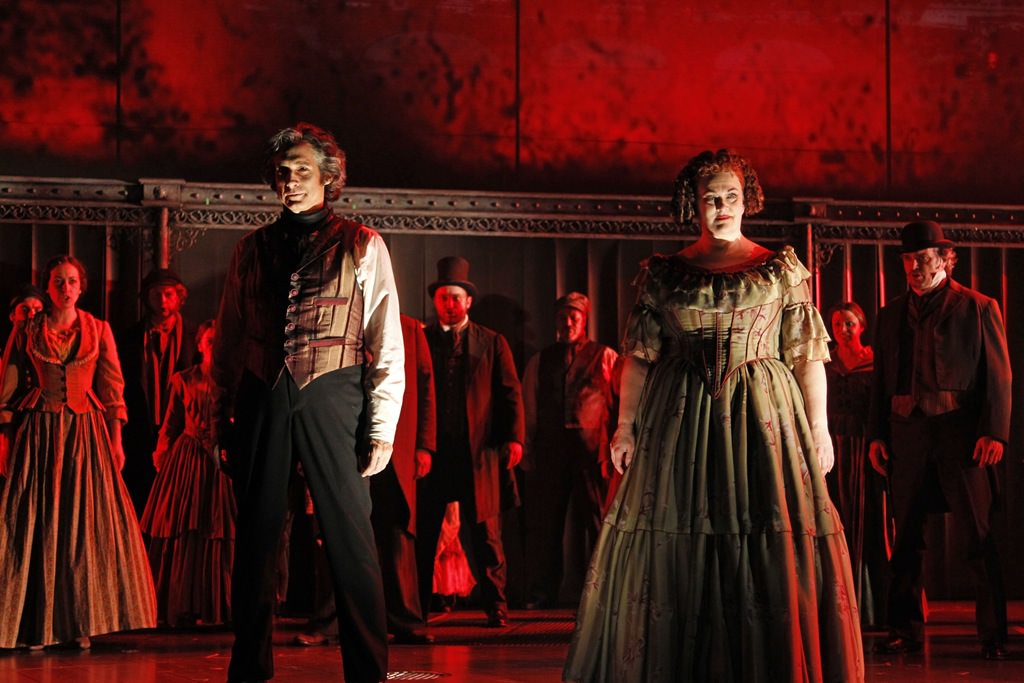
This photo is from a production of Sweeney Todd. Red is an intense color used to light the stage in this scene, only accompanied by dark shadows and minimal white lights. Bold and intense colors create tension on stage and the dark red light on the ensemble moves the front two actors to the center of the audience's attention. The lighting creates an eerie and sinister mood. The intense colors combined with sharp angles of shadows and lighting creates drama, suspense and tension on stage.
Source
Gobos/Texture - Pippin

This photo is from a production of Pippin. There is an interesting pattern created on stage with the projections. They show sharp, straight lines forming an intricate pattern that contrast with the projected images of tree branches. The stage is covered in bright yellow straight lines, forming a complex and repeating pattern, while the projection has dark curving lines. The repeated patterns all across stage highlight the center of the stage, where the actors are the only part that stands out as different. This combined with the bright light on them allows them to stand out from the stage. It appears as if there is a less evident pattern in the bright blue-white lights covering the actors, continuing the theme of patterns and projections. It creates a beautiful scene that is interesting to look at.
Source
Gobos/Texture - West Side Story

This photo is from a production of West Side Story. I like that there is a grid pattern formed on stage. The actors are mostly standing in line with the direction of the grid and the pattern itself creates tension on stage - there are harsh lines created by the pattern and the actors are half hidden by shadows. The pattern draws your eye across the whole stage and through the scene. The colors work well together in the scene to create tension along with the pattern.
Source
Friday, April 17, 2020
Dance Light

I liked this photo because I thought that the lighting on stage (or wherever they are performing) was executed very well to add to the performance while not making it over or underdramatic. For a group of dancers, I think that a big spotlight might be too much, but just simple mood lighting or cyc lights might not be enough. This scenario portrays lighting that focuses the dancers and keeps their facial expressions and movements as the focus.
Dance Row

I really liked this photo of these dancers because of the positioning of the light. The combination of the light coming from the side and the position that all of the dancers are in, it shields the front of their body from exposure, and sort of creates a half-light, half-dark scene. I think the different colors of light also helps create new skin tones for the dancers to possibly try to add to their appearance.
Subscribe to:
Posts (Atom)